
Miami-Dade · Broward · Palm Beach
AC Installation in South Florida
A new air conditioner from Cool Air USA starts with a free in-home estimate: a technician checks your current system (and the ducts, if you ask), then you get a digital estimate with your options and a fixed price. Every installation includes the city permit and inspection, a 1-year bumper-to-bumper labor warranty and up to 12 years on parts.
Free in-home estimate
City permit on every install
Background-checked technicians
Family-owned since 2008
 (877) 895-1155
Text us a photo of your AC’s labelFrom your phone, text a photo of your AC’s label to (877) 895-1155Age, size and refrigerant are on it.
1 Repair or replace
Do I need a new AC, or a repair?
Most air conditioners here last 8 to 14 years. A repair usually makes sense when the system is younger, or the problem is a capacitor, motor, drain line or thermostat. If the compressor or a coil fails on an older system, compare the repair price with a free estimate for a new one. The choice is yours; we give you both options.
A new system is worth pricing when
- The system is near or past its life expectancy and needs a major repair
- The compressor or a coil failed on an older system that’s out of its parts warranty
- It runs on R-22 (Freon) and needs refrigerant work (we don’t do refrigerant repairs on R-22 systems)
- Only the indoor or the outdoor unit failed and the other one is old: a new unit rarely matches an old one, and the permit requires a matched system
A repair usually makes sense when
- The problem is a capacitor, motor, drain line or thermostat: our vans come stocked for these repairs, so they’re usually done on the same visit
- The system is still under the manufacturer’s parts warranty: you pay for labor only
- The system is younger and otherwise in good shape
See AC repair: a $79 diagnostic for homes, waived with any repair.
Not sure how old your AC is?
Text us a photo of the label on your outdoor unit with your name and ZIP code, and it helps us prepare your free estimate.
How do I read my AC's label?
The label on the outdoor unit shows its age, size and refrigerant. How to read your AC's label →
2 Installation day
What happens on AC installation day?
From your approved estimate to a closed permit, in four steps.
-
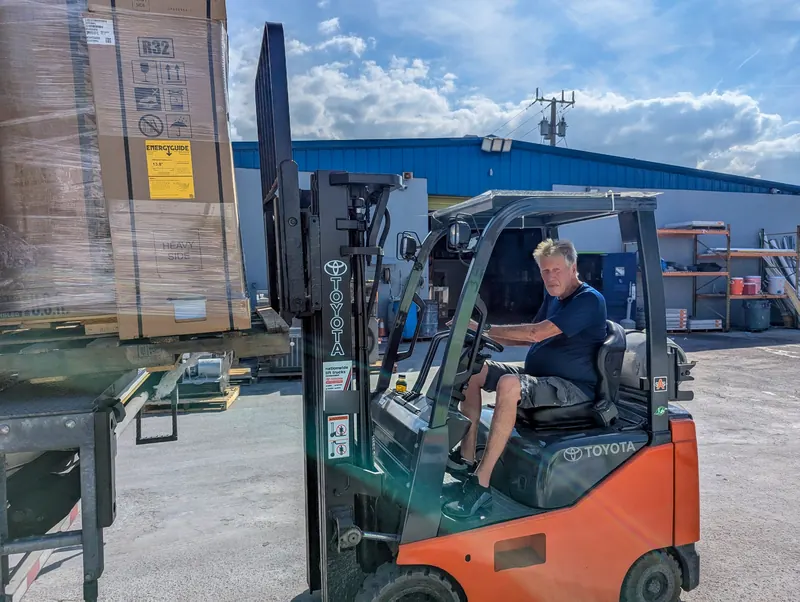
Order and receive
Once you approve the estimate, we order your new system and receive it at our shop.
-
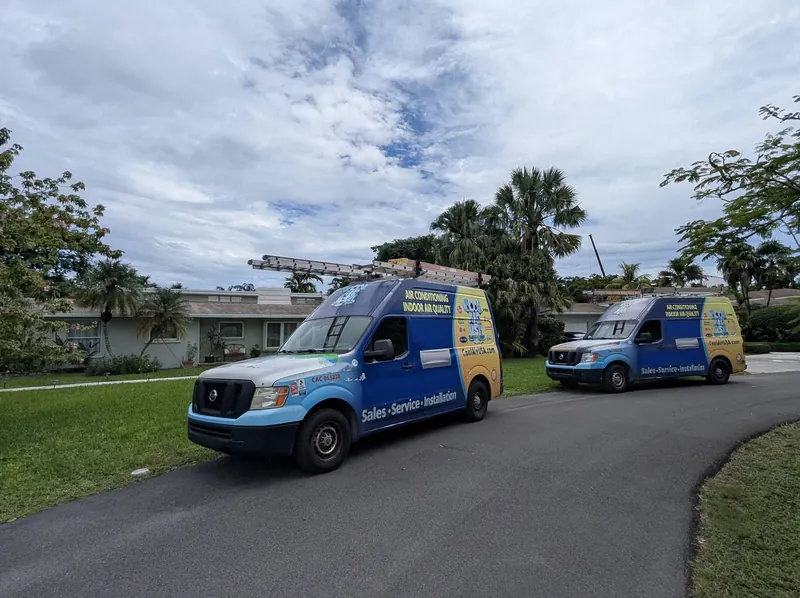
We arrive
Background-checked technicians in Cool Air USA vans, with the equipment from your estimate.
-
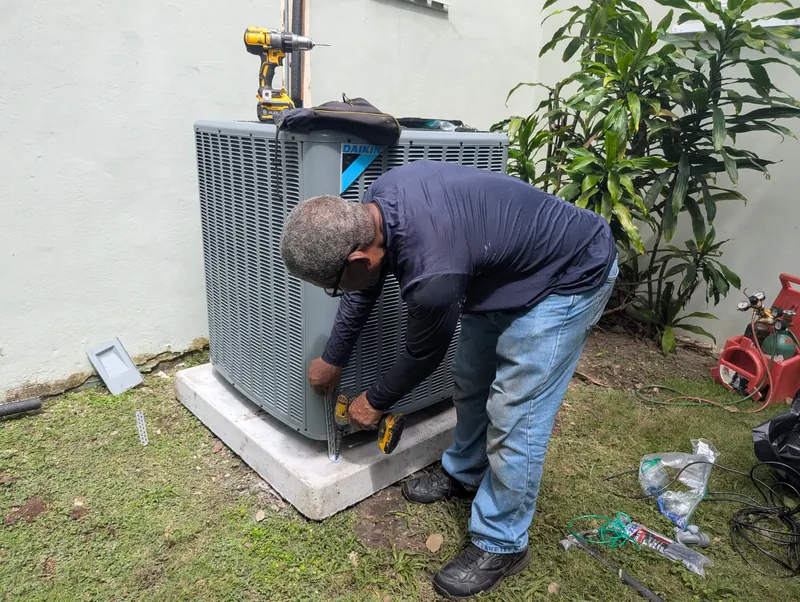
Install and connect
The old system comes out. The new condenser is set and strapped to its pad, the air handler goes in, and the copper line set is brazed and wired.
-
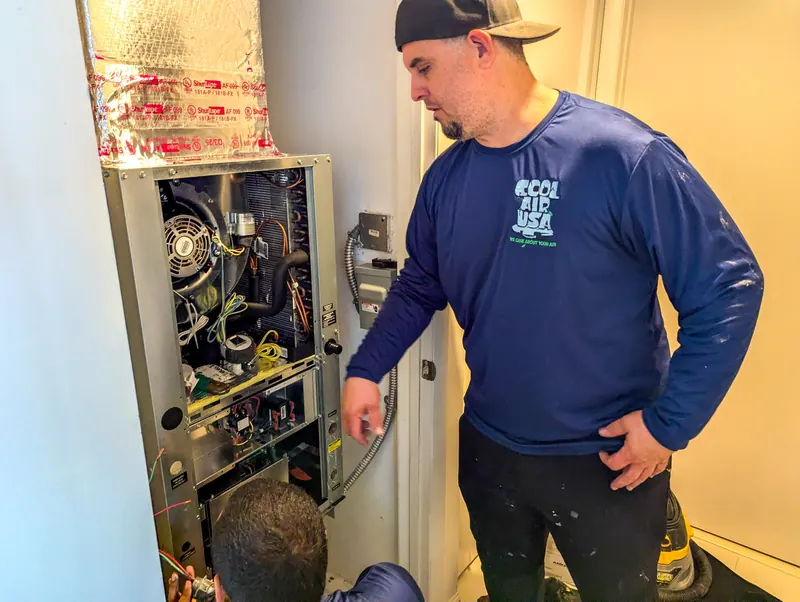
Start, test and inspect
We start the system and test it. The inspection is usually done within a week, and the permit is closed with your city.
How long does AC installation take?
About 6 to 10 hours on site for a split system, depending on the property. See it step by step →
3 Systems & brands
What AC system should I get?
For a house it comes down to three choices: the type of system, the brand and the efficiency tier. If your current size has worked well, we install the same size; if there's a reason to question it, we can run a heat-load calculation. Your free estimate shows the options side by side, with a fixed price for each.
For a condo it depends on how your building is cooled: a split system with its own condenser, or a water-source heat pump on the building's water loop. We check which one you have at the free estimate, and we coordinate the install with your building.
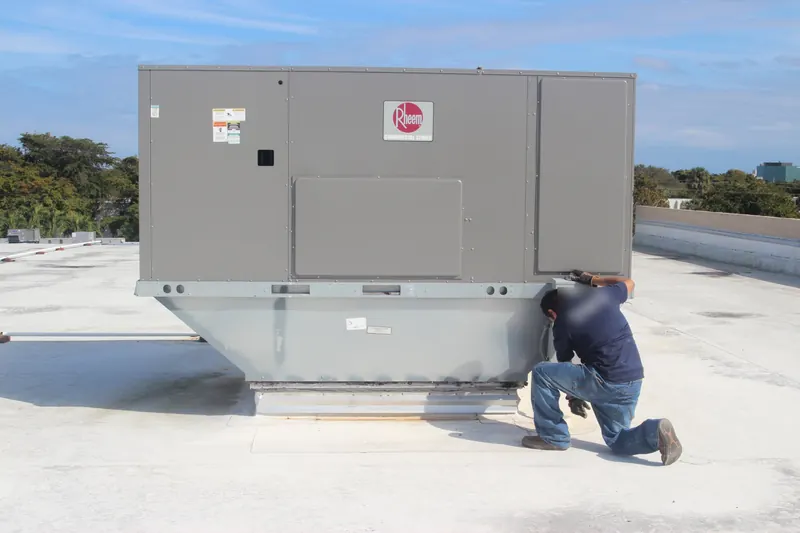
Most businesses run on a package unit, on the roof or on a slab, or on a split system. We size it to your building and its voltage, schedule the install around your hours, and give you a fixed price in a digital estimate before any work starts.
The systems we install
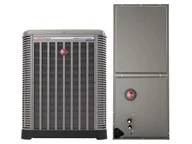
Split system
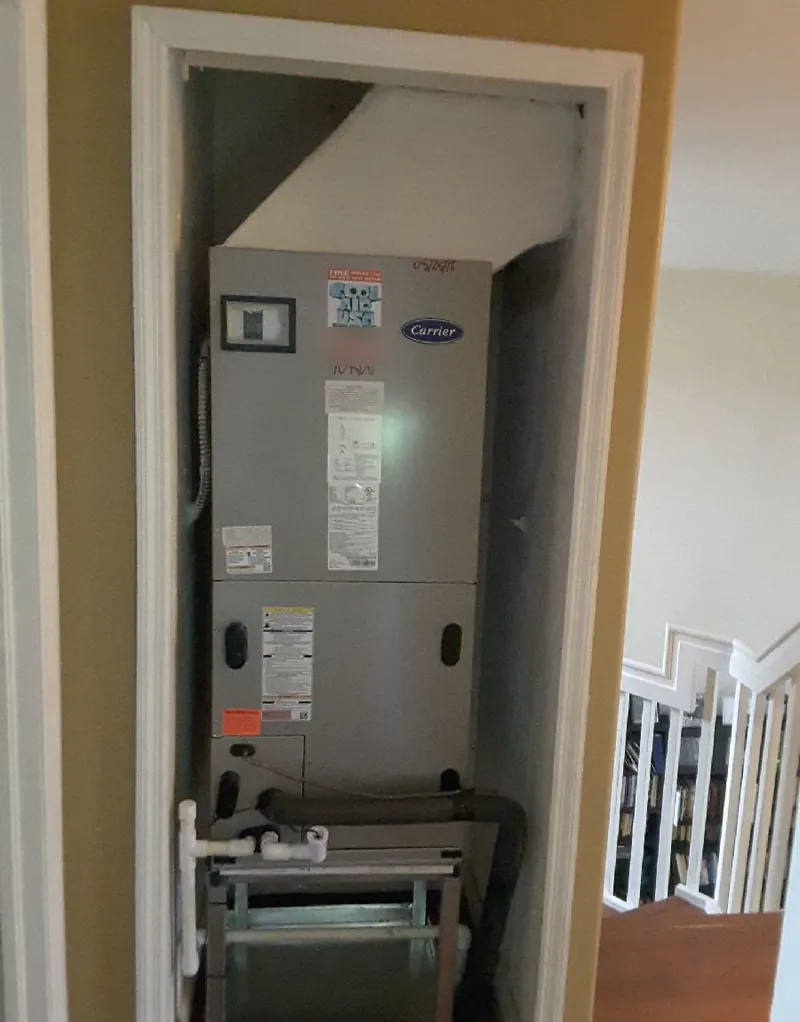
An outdoor condenser and an indoor air handler. The most common system in South Florida.
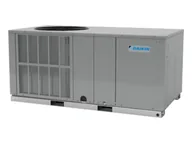
Package unit
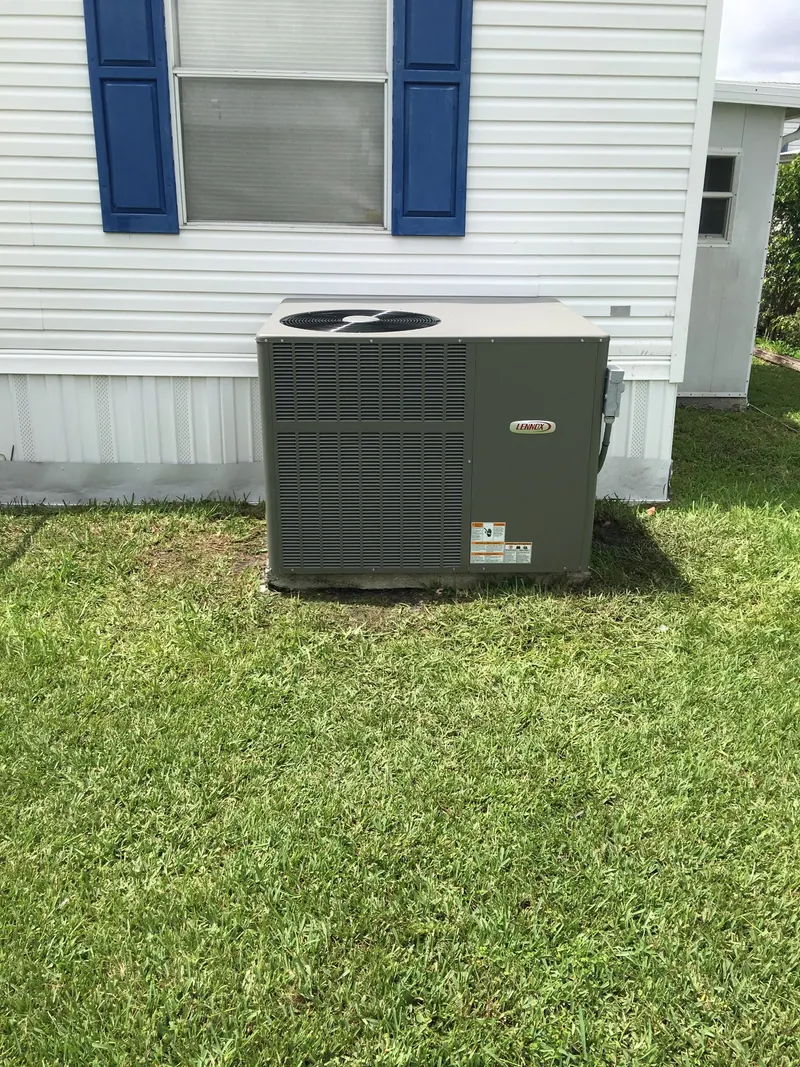
Everything in one outdoor cabinet, on the ground, a wall or a roof. Common on businesses and homes with flat roofs.
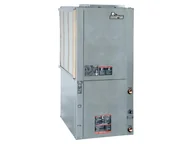
Water-source heat pump
For condos and high-rises: the unit runs on water from the building’s cooling tower.
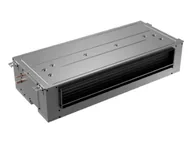
Pancake (low-profile) air handler
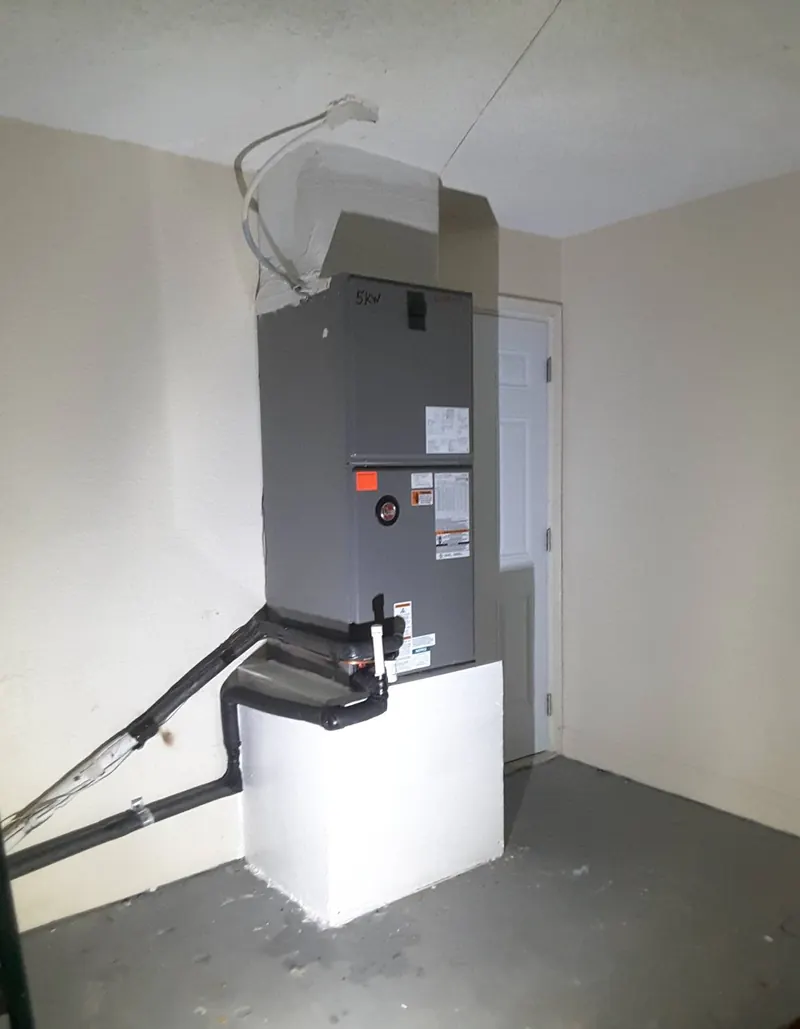
A slim air handler mounted in the ceiling, for apartments and condos with no room for a closet unit.
See every system that fits your space: pick the type, size and SEER2 and compare cabinet sizes, ratings and AHRI numbers before your free estimate.
Open the AC Estimator →We work with your building
- Before the install: access, elevator time and the certificate of insurance, arranged with the building.
- Where it sits: on the roof (a crane may be needed), in a closet, in the ceiling or hanging on a wall.
Bigger than 5 tons?
The lines below run 1.5 to 5 tons. For larger rooftop units, we handle light commercial systems up to 25 tons. See Commercial HVAC →
Which AC brand do we recommend?
To an extent, it’s a matter of preference. The brands below have high reliability ratings, and in our experience their warranty parts are usually in stock at local supply houses, though a part can still be back-ordered by the manufacturer. That isn’t true of every major brand.
For homes, we’ve had the most success with Rheem and Daikin. Here are the lines we install most, by tier.
For condos, we’ve had the most success with Rheem and ClimateMaster. Here are the lines we install most, by tier.
For businesses, we’ve had the most success with Rheem and Daikin. Here are the lines we install most, by tier.
 R-454B refrigerant
- Standard RA14, RP14, RA15, RP15 14 to 16 SEER2 1.5 to 5 tons.
- Two-stage RA16, RP17 15.2 to 17 SEER2
- Variable-speed (inverter) RD16, RD18, RA19, RP19 15.2 to 20 SEER2
- Package unit RACAYB, RACBYB 13.4 SEER2 Roof or slab, 2 to 5 tons.
 R-32 refrigerant
- Standard DC4SE, DC5SE 14 to 16.2 SEER2 Single-stage, 1.5 to 5 tons.
- Two-stage DC7TC, DH7TC 16.2 to 18 SEER2
- Variable-speed (inverter) FIT DC6VS, DH6VS, DH7VS, DC9VS, DH9VS 16.2 to 19.2 SEER2
- Package unit DP3CH, DP5HH 13.4 to 15.2 SEER2 Roof or slab, 2 to 5 tons. DP5HH is a heat pump.
 R-454B refrigerant
- Standard 5A7A4, 5A7A6 14.3 to 17 SEER2 Single-stage, 1.5 to 5 tons.
- Multi-speed 5A7A7 16 to 17.1 SEER2
- Variable-speed (inverter) 5A7V8X, 5A7V0X 18.1 to 23 SEER2
- Package unit 5TCC4, 5WCC4, 5WCZ5 13.4 to 15.2 SEER2 Roof or slab, 2 to 5 tons. 5WCC4 and 5WCZ5 are heat pumps.
 Water-source heat pumps · R-454B
- Condos and high-rises Tranquility 18 (SC) 12.7 to 15.2 EER (water loop) 1/2 to 5 tons, vertical or horizontal cabinet. Compact single-stage, built to replace older water-source units.
- Water coil Copper Copper as standard. Cupro-nickel can be ordered on request.
- 5-ton size SC060 The only size with enough refrigerant to require a refrigerant leak detector, so it comes with one.
We also install Carrier, Lennox, Bosch and First Co.




Which tier is right for you?
| Standard | Two-stage / multi-speed | Variable-speed (inverter) | |
|---|---|---|---|
| Compressor | Single-stage: runs at full capacity, then shuts off | Two-stage or multi-speed: ramps down to a lower stage when getting close to the set point, saving energy by running longer and avoiding start-up surges | Variable-speed: adjusts its speed to what the house needs |
| Efficiency | 14 to 17 SEER2 (package units 13.4 to 15.2) | 15.2 to 18 SEER2 | 15.2 to 23 SEER2 |
| Models | Rheem RA14, RP14, RA15, RP15 · Daikin DC4SE, DC5SE · American Standard 5A7A4, 5A7A6 | Rheem RA16, RP17 · Daikin DC7TC, DH7TC · American Standard 5A7A7 | Rheem RD16, RD18, RA19, RP19 · Daikin FIT DC6VS, DH6VS, DH7VS, DC9VS, DH9VS · American Standard 5A7V8X, 5A7V0X |
| Humidity control | Good | Better: longer, slower cycles pull more moisture out | Best: significantly more flexible and effective when dealing with humidity, the real comfort problem in South Florida |
| Best for | A straight replacement on a budget | Better comfort for most homes | The steadiest comfort and the highest efficiency we install |
SEER2 ratings depend on the matched indoor unit; your digital estimate shows the exact model numbers and rating for each option. Water-source heat pumps are rated in EER on the building’s water loop (AHRI/ISO 13256-1), not in SEER2.
4 Done right
How do I know an AC installation is done right?
Ask any installer three things: is there a permit, is the new system a matched system, and what labor warranty do you get. Here are our answers, so you can compare.
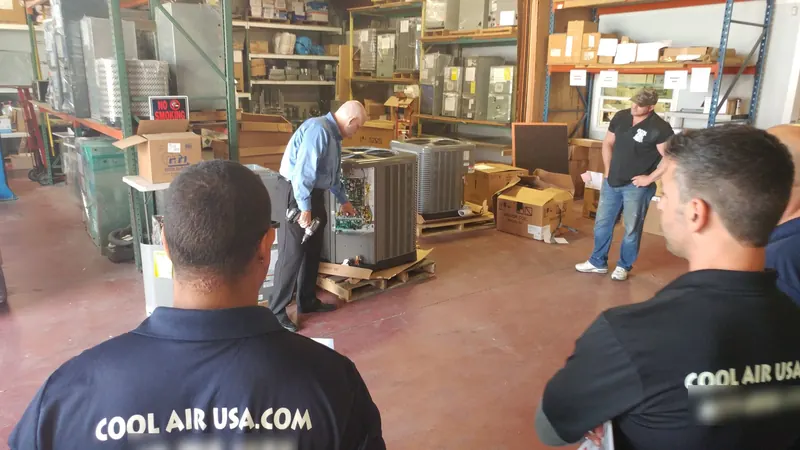
Recent installations
| Ask any installer | Our answer |
|---|---|
| Will you pull a permit? | Yes, on every installation, even a condenser-only swap. Permits explained → |
| Will the new system be the right size? | If your current size has worked well, the same size. If there's a reason to question it, we can run a heat-load calculation. How we size a system → |
| Will you check my ducts? | If you ask, yes: a new-system estimate doesn't include a duct check unless you ask for one. When there's a sign of a problem, we measure static pressure. Ducts and static pressure → |
| Is the new system a matched system? | Yes, listed together in the AHRI directory, as the permit requires. Why most jobs are full replacements → |
| What labor warranty do I get? | 1 year bumper to bumper: any issue in the first year after the installation is covered. Parts: up to 12 years, depending on the manufacturer. |
| Is the outdoor unit tied down for hurricanes? | Yes. Every installation uses engineer-approved tie-down specs, submitted with the permit. |
| Who comes to my home? | Background-checked Cool Air USA technicians in our own vans. |
Video reviews
Hear it from our customers
Cool Air USA installation customers, in their own words. Tap a video to watch it with sound; what each customer says is written out under it.
What they said
Hello, my name is Renato Cortez, and today I had John from Cool Air installing a new unit in my condo. I'm very satisfied with the job that they did and how they performed the job, how they explained all the details about the new unit. So I do recommend Cool Air for your AC needs.
What they said
Hi, I just want to say that David and Rolando from Cool Air USA were really great. They were fast, they did all the work appropriately, they cleaned up, they were very courteous, they were on time, and my whole experience was great. I will recommend it to anybody, and I will tell all my friends.
What they said
Yes, I had Cool Air USA technicians here this morning, and they did a very good job. They are very efficient and very polite. Thank you. I would recommend them to anybody else.
What they said
Okay, Cool Air USA, they're doing a really good job. I'm very happy. Fantastic. I recommend everybody. Thank you.
Reviews
What customers say about their new AC
Rated 4.9 across 4,975+ reviews, newest installation reviews first.
5 Cost & warranty
What does a new AC cost, and what's covered?
It depends on the system type and size, the efficiency tier, where the equipment sits and the condition of the ducts. The in-home estimate is free, and the digital estimate gives you a fixed price that includes the permit and inspection. Every new system comes with a 1-year bumper-to-bumper labor warranty and up to 12 years on parts.
What's covered
Paying over time? See financing options. FPL offers a rebate of up to $200 on qualifying high-efficiency systems in its service area. Manufacturers also run seasonal rebates; ask us what's available now.
What moves the price
| Factor | Why it matters |
|---|---|
| System/Size | A split system, package unit, water-source heat pump or pancake unit, sized to your home. |
| Efficiency | Standard, two-stage or multi-speed, or variable-speed. |
| Where | A roof (a crane may be needed), a closet, garage or attic, or a condo with building rules. |
| Ductwork | If you ask us to check the ducts and they're leaky or undersized, they may need sealing, repair or replacement; the estimate shows both options. |
| Copper line | We reuse your existing copper lines. If they leak, the repair is priced separately. Why → |
What do you reuse from my current system?
The copper lines, the wiring, the drain line and the main supply plenum, unless your estimate says otherwise. See the full list →
Service areas
AC installation near you
We install air conditioning across Miami-Dade, Broward and Palm Beach counties from our office in Lauderhill.
- Miami
- Fort Lauderdale
- Hollywood
- Pembroke Pines
- Miramar
- Miami Beach
- Plantation
- West Palm Beach
- Boca Raton
- Coral Springs
- Hialeah
All areas: Miami-Dade County · Broward County · Palm Beach County
FAQ
AC installation questions
Do I need a new AC?
How long does an air conditioner last in South Florida?
It's hard to give one number, but most air conditioners here last 8 to 14 years. Where yours lands depends on how often it's maintained, how hard it runs and where it sits: within a few miles of the ocean, salt air corrodes coils and electrical connections faster.
A system is usually replaced when the cost of repairs outweighs the cost of a new one. The technician gives you both options so you can decide.
Do you service R-22 air conditioners?
Yes, for electrical repairs. On R-22 systems we replace capacitors, contactors, transformers, control boards and motors. We don't do refrigerant repairs on R-22 systems, such as fixing leaks or adding refrigerant, because R-22 has been phased out and is in short supply.
New R-22 units are no longer made, so if your R-22 system needs refrigerant work, a new system is the way forward, and the in-home estimate is free.
How do I read my AC's label: age, size and refrigerant?
Every outdoor unit has a data label (the rating plate), usually on the side panel near the electrical box or where the copper lines connect. These five lines tell you most of what you need to know.
- 1
Model number: the size
Look for a number like 018, 024, 030, 036, 042, 048 or 060. It's the cooling capacity in thousands of Btu: divide it by 12 to get the tons. 036 = 36,000 Btu = 3 tons. Some brands, such as Goodman and Trane, show two such numbers; the second one is usually the size.
- 2
Serial number: when it was built
Most brands code the build date into the first digits. See "Find the year by brand" below.
- 3
Manufacture date
Many newer labels print it outright (MFD, DATE or FAB).
- 4
Refrigerant
Tells you the generation of your system, and whether a repair still makes sense.
- 5
Electrical
For the technician: breaker and wire size. You don't need this one.
Size: the number in the model
| In the model | Btu | Size |
|---|---|---|
| 018 | 18,000 | 1.5 tons |
| 024 | 24,000 | 2 tons |
| 030 | 30,000 | 2.5 tons |
| 036 | 36,000 | 3 tons |
| 042 | 42,000 | 3.5 tons |
| 048 | 48,000 | 4 tons |
| 060 | 60,000 | 5 tons |
Refrigerant: what it means for you
| R-22 | Phased out. Refrigerant work no longer makes sense; plan a replacement. |
| R-410A | Still serviced, but new R-410A systems stopped being made on January 1, 2025, so a matching new half is hard to find. |
| R-32 / R-454B | The current refrigerants, on systems made from 2025. |
Find the year by brand
| Brand | Serial starts | Reads as |
|---|---|---|
| Goodman, Daikin | 2204… | 2022, April |
| Rheem, Ruud | W4217… | Week 42 of 2017 |
| Trane, American Standard (2010 and newer) | 2124… | 2021, week 24 |
| Carrier and others | Formats vary: text us a photo | |
Common formats; some models differ. We confirm the date from your photo.
Still not sure? Text us a photo of the label and we'll tell you the age, size and refrigerant.
What system should I get?
Which systems do you install?
Split systems (an outdoor condenser with an indoor air handler), package units, water-source heat pumps for condos and high-rises, and pancake (low-profile) air handlers for ceilings. We don't install mini-splits, wall units or chillers.
Compare systems: see every matchup we install in our AC Estimator →
Which AC brand do you recommend?
To an extent, it's a matter of preference. Cool Air USA has had the most success with Rheem, Daikin and ClimateMaster units. These brands have high reliability ratings, and in our experience their warranty parts are usually in stock at local supply houses, though a part can still be back-ordered by the manufacturer. That isn't true of every major brand.
Within a brand, the choice is the efficiency tier: a single-stage system for a straight replacement on a budget, a two-stage system for better humidity control, or an inverter system for the steadiest comfort and the lowest FPL bill. Your free estimate shows the options side by side.
Compare systems: see every matchup we install in our AC Estimator →
Is my AC properly sized? How do you size a new system?
It depends on the heat load of the home. If the home keeps the same number of occupants and no major heat gain or loss has happened (an addition to the home, or a Bitcoin mining farm in the garage), the size that was right stays right. If your current size has worked well, we replace it with the same size.
The problem many South Florida homeowners face is a previous owner who replaced or upsized the system with no heat-load calculation. Unless the original unit is on file at the city building department, there is no way to verify the size wasn't already changed. If there's a reason to question it (an addition, rooms that never cool, a previous owner who upsized), we can run a Manual J heat-load calculation, and you can ask for one on any estimate. A heat-load calculation is an additional charge, and we tell you the price before we do it.
A Manual J looks at the insulation level, type and rating, the window type and size, the construction materials, the ceiling height, how many people live there and the direction the home faces, not just the square footage. Two homes with the same square footage can need different systems, which is why your neighbor's system may be a different tonnage than yours. Don't believe a contractor who says it's 500 square feet per ton; that's a rough guess, not a calculation. A bigger system isn't better either: it cools in short bursts and leaves the air damp.
Compare systems: see every matchup we install in our AC Estimator →
Can I install a bigger AC so the house cools faster?
Changing the tonnage can hurt comfort. The right size comes from the home's heat load, not square footage alone. An oversized unit cools the air quickly but shuts off before it removes the humidity, so the home feels cool yet clammy. An undersized unit runs for hours without reaching the set temperature. If you're unsure about the size, you can ask for a heat-load calculation at the free estimate (it's an additional charge).
What is a heat pump?
A heat pump is an air conditioner that can run in reverse. A reversing valve turns the cooling cycle around so the system moves heat into the home instead of out of it, without relying on a heat strip; most still have one as backup for the coldest nights. In a mild climate like South Florida it heats more efficiently than a system that heats with the strip alone.
Compare systems: see every matchup we install in our AC Estimator →
What does SEER mean?
SEER stands for Seasonal Energy Efficiency Ratio: how much cooling a system delivers per watt of electricity over a season. The higher the SEER (or the newer SEER2 rating), the less electricity the system uses to do the same cooling.
Compare systems: see every matchup we install in our AC Estimator →
Does salt air shorten the life of an AC, and should I get coastal-rated equipment?
Yes. Within a few miles of the ocean, coils, condenser fins and electrical contacts corrode noticeably faster than inland, and systems near the water wear out years sooner. Regular maintenance, where a technician inspects, cleans and tests the system, catches corrosion early.
When it's time to replace a system near the beach or an inlet, we recommend coastal-rated equipment with coated coils. The free estimate covers it, and the digital estimate shows the price before you decide.
Is it being done right?
Do you pull permits, and why does a new AC need one?
Yes. Every installation includes the building permit and the final inspection with the city or county building department, and we handle the paperwork; you don't need to visit the building department or call an inspector. The inspection is usually done within a week of installation day: a licensed private inspector checks the job by video call or photos, and the permit is closed with your city.
A permit is legally required for every HVAC contractor, and it protects you: it confirms the system was installed to code, it protects your manufacturer warranty, and it matters when you sell the home, since an unpermitted system can hold up a sale until a permit is pulled.
Do I need a permit to replace only the condenser or only the air handler?
Yes. In Florida, an AC changeout must be permitted with your local building department, and that applies to swapping only the condenser or only the air handler of a split system too. Don't be fooled by a contractor who tells you otherwise.
The permit also requires a matched system, so swapping only one half is rarely possible today.
If I replace the outdoor unit, do I have to replace the indoor unit too?
Usually, yes. The permit requires a matched system: the outdoor condenser and the indoor air handler have to be listed together in the AHRI directory. R-410A equipment stopped being manufactured on January 1, 2025, and new systems use the current refrigerants: R-32 on our Daikin lines, R-454B on our Rheem and American Standard lines. So a new outdoor unit rarely matches an older indoor one, which is why most jobs today are complete system replacements. The free estimate tells you what your system needs, with the price.
Do you tie down the outdoor unit for hurricanes?
Yes. This is very important in South Florida. Every installation we do uses tie-down specs that are engineer-approved and submitted with the permit, so your outdoor equipment stays secured in the worst weather.
Should I replace or seal old ductwork when I replace the AC?
Not always. A new AC is already a big investment, and new ducts make it bigger, so we start with the ducts you have. Many older South Florida homes still run on original ductwork: some of it is fine, and some has leaks, crushed runs or returns too small for today's equipment. Leaky ducts in a hot attic waste a share of the cooling you pay for.
A free estimate for a new AC doesn't include a duct check unless you ask for one, so if your home still has its original ductwork, ask us to check it. A duct estimate always includes it: when there's a sign of a problem, we measure the static pressure (how hard the system has to push air through the ducts). We only recommend new ducts when the static pressure shows a problem that sealing or repairs won't fix, and the digital estimate shows the options. We seal, repair and replace ductwork, and we test airflow after the work rather than assuming it improved.
Installation day
How long does AC installation take?
Installation time depends on the property: about 6 to 10 hours on site for a split system. Here is what to expect.
- Step 1
Arrival, walkthrough and prep
Shoe covers on, walkthrough to confirm the plan from your estimate, drop cloths and moving blankets down, tools brought in.
- Step 2
Removing the old system
Power off at the panel. Copper lines, drain and ducts disconnected, tie-downs removed, and the old equipment hauled away.
- Step 3
Setting the new units
The slab is leveled, the condenser set on vibration pads, the air handler mounted, and the copper lines flushed.
- Step 4
Getting connected
Lines brazed, drain re-piped, wiring connected, supply plenum sealed. Nitrogen leak test, then vacuum to 500 microns.
- Step 5
Start-up
Refrigerant valves opened, the system runs 30 minutes, charge confirmed. Pressures, subcool, superheat and temperature split recorded.
- Step 6
Clean-up and walkthrough
Work area cleaned and tools loaded back on the truck. We show you the thermostat, the filter and the monthly drain treatment, then you sign off.
What's involved in installing a new AC system?
It starts with a free in-home estimate: a technician checks the current system and the drain line, and the ducts if you ask, because a new condenser on leaking, undersized ducts will never deliver what the label promises. You get a digital estimate with a fixed price.
Where the equipment sits shapes the job: on the roof (a crane may be needed), outside the house, in a closet, garage or attic, or hanging on a wall. Every installation includes the city permit and inspection, and we handle the paperwork. For condos we coordinate access, elevator time and the certificate of insurance with the building before the install date.
Which water shutoff valve is better for an AC: a gate valve or a ball valve?
A ball valve. The two most common water shutoff valves in South Florida are gate valves and ball valves. Gate valves are more economical, but they are often more problematic: they take longer to close, they are highly susceptible to seal failure, and overtightening an older one often snaps the internal stem. Ball valves shut the water off quickly, are highly durable, and rarely stick or leak. That's why we use ball valves on all our plumbing and air conditioning installations.
Do I need a Y-strainer on my AC?
On a water-source system, a Y-strainer is a valuable accessory. It filters sediment out of the water supply before it can clog the coil, saving you from expensive backflush treatments. How well it works depends heavily on your building's water quality and cooling tower maintenance: poor water quality leads to frequent clogs that shut the AC down and let the indoor temperature rise. If your supply lines carry high levels of contaminants, a Y-strainer will need frequent manual cleaning to keep the system running smoothly.
Cost, warranty and rebates
Is the estimate for a new system free?
Yes. The in-home estimate for a new system is free. A technician checks your current system and the drain line, and the ductwork if you ask (and can run a heat-load calculation, for an additional charge, when the size is in question or you ask for one), then you get a digital estimate with a fixed price that includes the permit and inspection.
How does the warranty work on a new system?
Every new system comes with a 1-year bumper-to-bumper labor warranty from Cool Air USA: any issue in the first year after the installation is covered. The manufacturer's parts warranty runs up to 12 years, depending on the manufacturer.
After the first year, the manufacturer covers the parts and you pay for labor only. Repairs we make after that carry our own 1-year parts and labor warranty. The exact terms are on your contract.
Does a new AC come with a thermostat?
Yes. A new system that uses a 1-heat/1-cool thermostat comes with our Cool Air USA thermostat, a Honeywell Home FocusPRO. Variable-speed systems need the brand's own thermostat, the Daikin One+, the Rheem EcoNet or the American Standard Link, to run at the right speed. That one is shown as its own line in your estimate.
What do you reuse from my current system?
A new system connects to what is already in your home. Unless your estimate says otherwise, we reuse the copper line set between the air handler and the condenser (flushed clean first), the high-voltage wiring, the low-voltage wires from the thermostat to the air handler and the condenser, the drain line (cleaned) and the main supply plenum (resealed).
If the line set leaks, we find it during the nitrogen test on installation day; often it can't be found before then. A repair or a new line set isn't part of the new-system estimate unless your estimate says so. The installer flags it, and our office gives you a price.
Do I need to register my new AC system to get the warranty?
Not anymore. Since July 1, 2024, Florida law no longer requires homeowners to register a system to receive the manufacturer's extended parts warranty, and the warranty stays with the home if you sell it.
Are there rebates or tax credits for a new high-efficiency system?
FPL offers a rebate of up to $200 on qualifying high-efficiency systems in its service area, and manufacturers run seasonal rebates on some lines; ask what applies to the system you're considering.
The federal energy-efficiency tax credit for central air conditioners and heat pumps (section 25C) ended for systems installed after December 31, 2025, so systems installed now don't qualify for it. Check with your tax professional for anything that applies to your return.
More questions? See our complete HVAC & plumbing FAQ, or call or text (877) 895-1155, a real person answers 24/7.
Ready for a free estimate?
A technician checks your system, and your ducts upon request, then sends a digital estimate with your options and a fixed price, permit and inspection included.